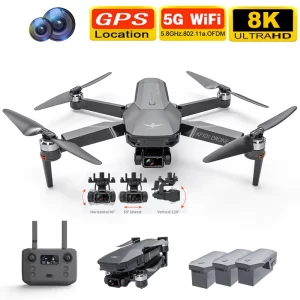
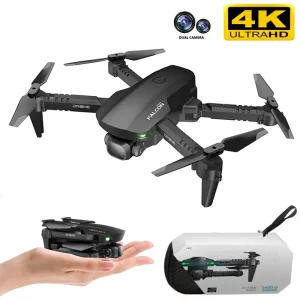
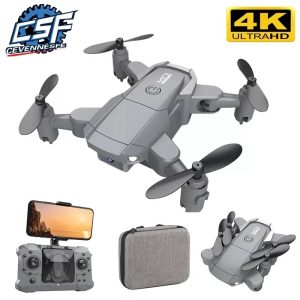
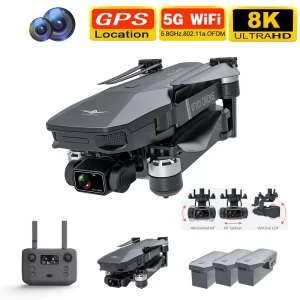
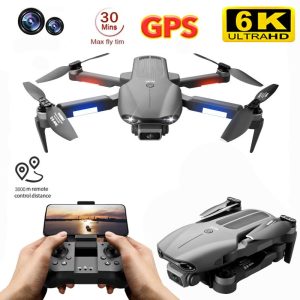
Abstract: A quadcopter is also known as a quadrotor aircraft, or quadrotor helicopter. The four propellers of the quadcopter are all simple mechanisms with the motors directly connected. The cross-shaped layout allows the aircraft to obtain the force to rotate the fuselage by changing the motor speed, thereby adjusting its attitude. There has never been a large commercial quadcopter in history because of its inherent complexity.
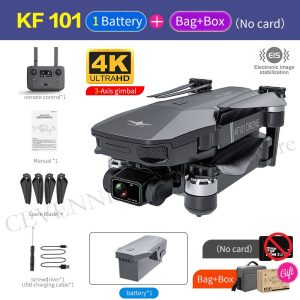
In recent years, thanks to the development of micro-electromechanical control technology, stable quadcopters have received extensive attention, and their application prospects are very considerable. In the future, quadcopters will be widely used in security, construction and other high-risk fields. Let’s take a look at the details below.
1.Structural Principles of Quadcopters
A quadcopter is a vehicle with 6 degrees of freedom of movement in space. They are translation and rotation along the three coordinate axes respectively. But there are only 4 control degrees of freedom (the rotational speeds of the four motors) for the system. So it is called an underactuated system. There is a complete drive system when the control degrees of freedom equal the motion degrees of freedom. But for the attitude control itself (rotational action along 3 axes respectively), it is indeed completely driven.
Compared to helicopters, quadcopters can achieve fewer flight attitudes. However, the basic forward, backward, translation, and other states can be realized. However, the mechanical structure of the quadcopter is far simpler than that of the helicopter, and the maintenance and replacement costs are also very small, which gives the quadcopter a greater application advantage than the helicopter.
Principle of automatic control
To maintain the stable flight of the aircraft, an inertial navigation module composed of 3-directional gyroscopes and 3-axis acceleration sensors is installed on the quadcopter, which can calculate the attitude, acceleration, and angular velocity of the aircraft relative to the ground at this time. The flight controller calculates the rotational force and lift required to maintain the motion state through an algorithm, and uses the electronic controller to ensure that the motor outputs the appropriate force.
2.The development direction of quadrocopter
As one of the most popular aircraft nowadays, quadcopters have attracted more and more attention from science enthusiasts and commercial companies. It can be seen from Amazon’s idea of using a quadcopter to deliver packages to customers. It can be said that the future application prospects of quadcopters are very broad.
The quadcopter referred to here is not only a quadrotor but also a common name for an aircraft with more than one aerodynamic rotation axis. The future development direction of quadcopter mainly includes the following aspects:
First, it can be used as a new concept means of transportation. As early as World War II, the prototype of the manned four-axle had been designed. However, because the control technology cannot keep up, the aircraft cannot be put into practical application due to instability.
The second is the field of security. With the continuous development of artificial intelligence, quadcopters equipped with high-definition cameras and various security equipment will be widely used in the fields of public security, fire protection, family and unit security. Four-axis will become extremely intelligent and agile electronic police, electronic firefighters, electronic security, and electronic housekeeper. Maybe in the near future, you will feel incredibly caring and safe because you have a flying family babysitting robot.
The third is the construction field and its high-altitude working environment. The video of building a building with a quadcopter shown at the TED conference may have been seen by many enthusiasts, which is quite a promising application. Rather than 3D printing a house, it is more practical, flexible, and efficient to build a massive building with a swarm of tiny quadcopters. Maybe one day you pass by a construction site and see that overhead is not a group of construction workers, but a group of humming quadcopters working in an orderly manner, then don’t be surprised by what you see.