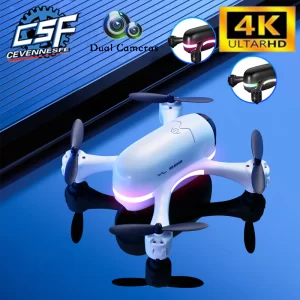
I had seen lots of UAV flight accident. I summarized a tutorial for the problems that beginners are prone to. As long as you carefully read all the below, and then practice them one by one to ensure a safe journey.
1、 Do three things first when you get the new UAV
For beginners, it is forbidden to play drone as soon as they get it. Many tragedies come from this mentality of eager to fly. First, do these three things:
1. Read the user manual and eliminate common problems for novices
In the product page, you can find the user manual, Carefully read the operating instructions to understand the functions, operating environment and precautions of the drone
2. Practice simulated flight and understand thE operations
Before flying, you can more intuitively understand the flight attitude and direction changes corresponding to the remote control hitting operation by simulating the flight function.
3. Novice mode practice first
When the UAV is activated, the app will prompt whether to start the novice mode to limit the flight distance, altitude and speed of the aircraft. It is recommended that novices do not turn off this mode to ensure that the UAV can fly within the visual range.
Notes for selecting UAV flight environment
The first thing of UAV flight safety is to select the appropriate flight environment, which can effectively reduce the risk of UAV explosion.
1. Avoid small obstacles
For kite lines, wires, branches, transparent glass and water, it will be difficult for UAV to detect and identify. Therefore, pay attention to observe the environment during UAV flight, and do not rely too much on the visual obstacle avoidance system.
2. Avoid birds and animals
UAV flying in the air may invade the airspace of some birds, causing attacks by birds and accidents; At the same time, the ultrasonic wave emitted by the UAV may also cause anxiety to other animals. So please choose an environment away from animals.
3. Avoid flying in densely populated areas
UAV is easy to attract crowds to gather around, thus affecting the operation and judgment of the player; If you encounter unexpected dangerous situations during flight, it may threaten the personal safety of others. Therefore, you should avoid flying in densely populated areas.
4. Keep away from compass interference source
In dense building areas, near metal buildings such as high-voltage lines, or in environments with strong magnetic fields (such as basements and power stations), the UAV compass is prone to abnormalities. At this time, if it takes off forcibly, it may have unstable flight attitude and drift around.
5. Understand weather conditions
Carefully understand and study the weather forecast before takeoff to avoid rain, snow and hail during flight etc. In addition, when flying in winter, pay attention to whether the ambient temperature is suitable for flying, and wait until the battery cell temperature rises to 20 degrees, and ensure that the battery power is normal before flying.
6. Need to be careful when flying at night
Flying at night, although interesting, is still avoided for beginners. Due to the low visibility at night and the unavailability of obstacle avoidance at night, UAV flight is prone to potential safety hazards, and many national and regional laws and regulations prohibit night flight.
7. Pay attention to local laws and regulations
Before takeoff, it is necessary to understand the relevant provisions of local laws and regulations on UAV flight, especially the relevant provisions on the no fly zone.
3、 Make three preparations before takeoff
1. Confirmation and preparation
Confirm whether the power of UAV and remote control can fly normally
Confirm whether the blade is intact and installed correctly
Confirm whether the compass is calibrated
Set low battery alarm
(before flight, it is recommended to turn on the remote control first and then the aircraft to keep the aircraft under control.)
2. Set return altitude
You need to set the safe return altitude in advance. It is recommended that you set it reasonably according to the obstacle altitude of the flight environment. Generally, beginners are advised not to exceed the sight range and control the flight altitude below 120 meters.
3. View GPS signal
Before takeoff, you also need to check the satellite signal (it is recommended that the number of satellites should be more than 10, and the signal should be greater than 4 grids). Sufficient GPS signals can ensure that the aircraft can fly stably.